The Features and Applications of Vertical Injection Moulding Machines with Rotary Table
Introduction
In the plastic injection moulding industry, efficiency and precision are crucial for meeting production demands. Among the many types of moulding equipment, the vertical injection moulding machine with rotary table stands out for its ability to improve productivity, enhance automation, and ensure secure insert placement.
This article provides an in-depth look at the classification of vertical injection moulding machines, the working principles of rotary table systems, and the advantages they bring to modern manufacturing applications.
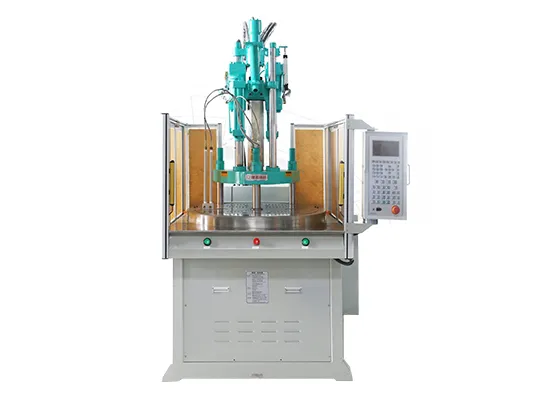
1. Classification of Vertical Injection Moulding Machines
Vertical injection moulding machines are widely used in plastics and rubber processing, offering unique benefits compared to traditional horizontal machines. Their vertical clamping and injection design allows better control over insert moulding and makes them suitable for specialized applications.
These machines can be classified based on two aspects:
Injection Direction
Horizontal Injection
Vertical Injection
Clamping Template Configuration
Single-Slide Type – simple design, suitable for smaller parts.
Double-Slide Type – enables alternating operations, reducing idle time.
Rotary Table Type – allows multiple moulds to rotate alternately, significantly increasing productivity.
2. What is a Rotary Table Vertical Injection Moulding Machine?
A rotary table vertical injection moulding machine features a lower clamping platen that rotates to support two or more moulds. While one mould is in the injection stage, the other is accessible for inserting components or removing finished parts. This setup enables simultaneous operations of:
Moulding
Insert loading
Part removal
By alternating between moulds, the rotary system ensures continuous production without unnecessary downtime.
3. Advantages & Features of Rotary Table Vertical Injection Moulding Machines
Rotary table systems are widely adopted in industries such as:
Automotive parts manufacturing
Electronic components
Consumer goods and housewares
Metal–plastic hybrid products
Key Advantages:
Higher Productivity
Continuous operation with two or more moulds reduces cycle time.
Insert placement and part removal can occur while moulding is in progress.
Compact Footprint
Vertical design saves floor space, making it ideal for factories with limited working areas.
Accurate Mould Alignment
Rotary tables are designed with precision positioning systems to ensure consistent mould alignment, reducing defects.
Automation-Friendly
Compatible with robotic arms and automated handling systems, enabling fully automated production lines.
Flexible Station Options
Standard configurations include two-station rotary tables, but advanced models can support three or even four stations for greater efficiency.
Enhanced Safety and Stability
Strong clamping systems ensure stability during the injection process, while advanced monitoring systems allow real-time detection of any abnormalities.
4. Production Applications and Examples
Rotary table vertical injection moulding machines are especially suitable for insert moulding and multi-material moulding. For example:
Automotive Industry: embedding metal parts into plastic housings for switches, connectors, and dashboard components.
Electronics Industry: insert moulding of circuit boards, sockets, and precision connectors.
Household Appliances: producing overmoulded handles, grips, and dual-colour components.
Medical Equipment: creating precise plastic parts with embedded inserts for devices requiring high accuracy and reliability.
By combining multiple moulds and automated handling systems, manufacturers can achieve continuous production while maintaining quality standards.
5. Intelligent Manufacturing and Process Control
Modern rotary table vertical machines often integrate advanced control systems, which provide:
Full production process monitoring – ensuring stability across cycles.
Data collection and analysis – tracking output, downtime, and machine efficiency.
Real-time fault detection – identifying micro-abnormalities before they escalate.
Remote monitoring and troubleshooting – allowing technicians to manage systems offsite.
Authorization management – securing operational safety and preventing unauthorized access.
These features help manufacturers transition towards smart factory solutions, where efficiency, automation, and quality control are seamlessly combined.
Conclusion
The rotary table vertical injection moulding machine is a versatile and highly efficient solution for industries that demand precision, flexibility, and continuous production. By combining compact design, automation compatibility, and intelligent control systems, it addresses the challenges of modern manufacturing while driving significant improvements in both productivity and product quality.
As global demand for complex plastic components continues to grow, rotary table vertical injection moulding machines are set to play a vital role in the future of efficient, automated, and intelligent production.


评论
发表评论